Showing posts with label literature. Show all posts

Sunday, July 21, 2013

Ernest Hemingway, one of my all-time favorite writers! Happy 114th birthday!

Let us remember and honor the great novelist and journalist, winner of the Nobel Prize for Literature, one of my all-time favorite writers---Ernest Hemingway---today on his 114th birth anniversary.

Image of Hemingway below, sourced from guardian.co.uk


Ernest Miller Hemingway (July 21, 1899 – July 2, 1961) was an outstanding American author and journalist. Hemingway produced most of his work between the mid-1920s and the mid-1950s, and won the Nobel Prize in 1954.

This image below of the 1954 cover of Time magazine on Hemingway, sourced from time.com


I admire Hemingway's powerful yet understated, elegant yet economic and clean literary writing style as well as his robust, adventurous life!


Image below of Hemingway in his youth, sourced from en.wikipedia.org


Hemingway published seven novels, six short story collections, and two non-fiction works.

Some of Hemingway's works:

Indian Camp (1926)
The Sun Also Rises (1926)
A Farewell to Arms (1929)
"The Short Happy Life of Francis Macomber" (1935)
For Whom the Bell Tolls (1940)
The Old Man and the Sea (1951)
A Moveable Feast (1964, posthumous)
True at First Light (1999)

Image below of Hemingway's novel For Whom The Bell Tolls, sourced from washingtonpost.com


I had recently bought a private resort in Pansol, Laguna from the Collantes family, renamed it Hemingway Eco-Resort, and I'm now renovating this garden-style and tropical-inspired private resort as my humble way of honoring this outstanding and great writer.


Hemingway image below, sourced from gepl.org


Friday, May 3, 2013

Private resort in hotspring capital Pansol, Philippines named after great romantic poet from Chile

Neruda Resort in Pansol honors world’s greatest poet of the 20th century


            Just a little over half an hour from Makati and below the slopes of Mount Makiling in the Philippines' hotspring capital of Pansol in Calamba City, Laguna province, a new oasis for leisure has recently opened---a private resort with two swimming pools, kitchen, barbecue grill, videoke, air-conditioned rooms good for 30 people---with Neruda Hotspring Resort at address 724 Natalie Street, Norville Subdivision, Purok 5, Pansol (very near and on the way to La Vista Pansol).

            Named in honor of great Chilean poet, writer, diplomat, Nobel Prize winner and statesman Pablo Neruda whom Colombian writer Gabriel Garcia Marquez called “the greatest poet of the 20th century in any language”, Neruda Hotspring Resort is an elegant private resort with two swimming pools, air-conditioned rooms good for over 30 people, modern karaoke and sound system, kitchen and barbecue grille, and a social hall or seminar place. It is also the only resort in Laguna with a free library of books, mostly on poetry.

           The natural mineral-rich hotspring water pools have medicinal or therapeutic benefits to health, like lower blood pressure, eliminate toxins, help better sleep, improve joint and muscle mobility.

Now popular for summer outings, Neruda Resort Pansol is also ideal for romance like dates, a private wedding celebration or even for the most unforgettable wedding proposal.  Poets, writers, artists and teachers will be given special discounted rates, just go to the Neruda Hotspring Resort Facebook page  https://www.facebook.com/pages/Neruda-Hotspring-Resort/118129861706136?ref=ts&fref=ts. Call or text Rose 09228901892 or Grace 09255877878 or email gh_realty@yahoo.com for inquiries, reservations and special discounted rates.


Below is an old photo of poet Pablo Neruda in is youth


Poet, diplomat and activist politician Pablo Neruda in his youth and latter years


Tuesday, December 25, 2012

A 2012 Rodel Tapaya oil on canvas painting tribute to the Nobel Prize-winning writer Gabriel Garcia Marquez, as published in the "Philippine Star" newspaper.

This painting is in the collection of Wilson Lee Flores.

Both the painter Tapaya and Wilson Lee Flores admire Colombian novelist/journalist Gabriel Garcia Marquez among their favorite writers.

The multi-awarded University of the Philippines (U.P.) Fine Arts graduate Rodel Tapaya is one of the most accomplished painters of Asia---an artist of remarkable talent, exuberant creativity, high intellect, passion and bold vision.


RECENT UPDATES ON RODEL TAPAYA:


T A P A Y A    U P D A T E S

Present/Current
Present/CurrentCCP Thirteen Artist Exhibit
Cultural Center of the Philippines
CCP Complex, Tanghalang Pambansa
Roxas Boulevard, Pasay City, Philippines
on view until February 2013
Tuesdays - Sundays  10am - 6pm

Past / Previous

Enduring Commitment: New Acquisitions (2009-2011)The Bangko Sentral Collection (Central Bank of the Philippines Collection)
MET Metropolitan Museum of Manila
on view until December 15, 2012
Mondays - Saturdays 9am - 6pm
Bangko Sentral ng Pilipinas Complex,
Roxas Boulevard, Malate-Manila
02-7087829/ 708-7828
info@metmuseum.ph

Mystic Origins: Plants I
Solo Exhibition
WADA Fine Arts, Tokyo
October 1-27, 2012

DEITIES
Solo Exhibition
West Gallery, Quezon City
November 6-17, 2012

Art TAIPEI
Group Exhibition
WADA Fine Arts at Taipei World Trade Center
November 9-12, 2012

Upcoming/Future
New Acquisitions by Pinto Art Museum
Rodel Tapaya Work
Pinto Art Museum
Silangan Gardens, 1 Sierra Madre Heights, Antipolo City
opens on Dec 16, 2012

***


Image of the topnotch international painter Rodel Tapaya, whose works are much sought after by top collectors in Asia and beyond. Source: Yahoo Singapore


November 20, 2011 article by Yahoo Singapore on Rodel Tapaya victory of another major award then.

By Sheela Sarvananda


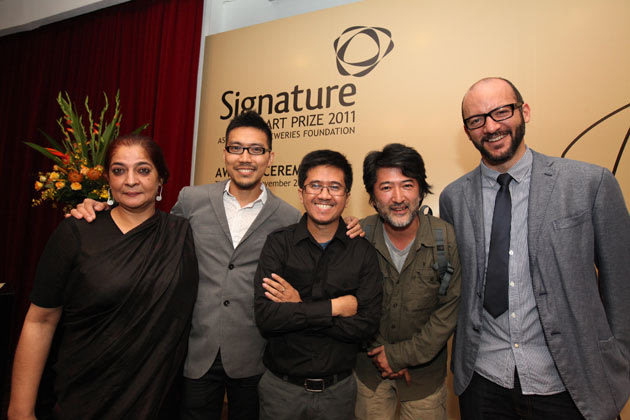
Within the restored colonial confines of the Singapore Art Museum (SAM) on Thursday, artists, guests and media gathered to celebrate artistic excellence in Asia Pacific.


The artworks of 15 finalists, nominated from 24 countries and territories, were presented for the Asia Pacific Breweries (APB) Foundation Signature Art Prize 2011 in a ceremony organised by the museum.


The extensive selection of the finalists from a pool of 130 artworks was carried out by a group of eminent art experts.


With the emphasis on a single signature work of each contender, artists are provided with an uncommon benchmark for all artists — whether they have a long, pedigreed history or not.


Tan Boon Hui, director of SAM, said the focus is to level the playing field and to bring it back to basics: appreciating art for its own sake.


Inaugurated in 2008 and held every three years, the awards aim to cultivate the vibrancy of art-making in Asia Pacific today. The stage has been set for these artists to showcase their artisanal skills to a wider
audience, giving them a platform for recognition they would be hard-pressed to find elsewhere.


"In a competition like this, in which it is open to both emerging and established artists, it is structured to award the prize for a single artwork. It really looks at excellence in the work, so everyone competes on an equal footing. That's very important in opening up the possibilities to look at a diverse a selection of art from the region," Tan said.


The grand prize was presented by Grace Fu, Senior Minister of State for Information, Communications and the Arts.


Grand prize winner Rodel Tapaya, from the Philippines, took home $45,000 for his painting Baston ni Kabunian, Bilang Pero di Mabilang (Cane of Kabunian, numbered but cannot be counted).


The floor-to-ceiling work is an impressive sight to behold, with a dynamic interplay of the past and present. It reflects the folkloric roots interwoven into the history of Tapaya's people, as well as the underlying themes of the devastating effects of nature. Bold colors abound, and even from a distance, painstaking brushstrokes and lovingly-executed details are evident, even to the untrained eye.


Tapaya said that his art is multi-layered in approach. "Philippine folklore is my world, the main theme I create in my work. But I want the viewer to not just see my painting as stories. I want him to look at the deeper perspective, too. So, I added some commentary on why we experience great floods, global-warming, deforestation," he pointed out.

Singapore's very own Michael Lee was also a winner on the celebratory night as he walked away with the People's Choice Award worth $10,000. This was presented by Michael Koh, CEO of the National Heritage Board.


Lee's Second-Hand City is a suite of eight digital prints exploring contemporary life with wit and insight into the machinations of everyday existence. His work showcases an insightful dialectic on living in a concrete jungle — using urban architecture, science fiction and pop culture as his palette and salvo.


This award in particular is the result of the public voting online at SAM's website, or casting their votes in person at the exhibition, prior to the 17th of November date of the ceremony. Lee's art is the undeniable hot-favorite with the public, and deservedly so.


Lee said he creates utopian architecture to encourage dialogue away from polarising debates on conservation. While some might believe conservation is key and others advocate the new as penultimate, he believes a middle-ground is where the answer lies.


"My position begins with moving out from moralising, taking a judgmental position. Morality is important to a certain extent. At its best, it pushes human being to be better. But very often, rules and norms make us complacent and unable to think out of the box — people may not even know they have been restricted. So when I propose imaginary buildings and impossible cities, I'm not saying these are my proposals as a solution. I want my work to be triggers through humor and irony, to get people to see things from a bigger perspective," he explained.


L-R Sheba Chhachi (Jurors Choice), Michael Lee (People's Choice), Rodel Tapaya (Grand Prize), Aida Makoto (Jurors Choice), Daniel Crooks (Jurors Choice). (Photo courtesy of Singapore Art Museum)L-R Sheba Chhachi (Jurors Choice), Michael Lee (People's Choice), Rodel Tapaya (Grand Prize), Aida Makoto (Jurors …


During the night, four more artists were presented awards. Three Jurors' Choice Awards, worth $10,000 each, were given to Daniel Crooks from Australia, Sheba Chhachhi from India and Aida Makoto from Japan. These were presented by Roland Pirmez, advisory committee chairman and board of trustees member of the APB Foundation.


Pirmez spoke of the importance of the melting pot of cultures in the region.


"The foundation was set up to applaud and celebrate the diversity of life, as showcased in the artwork of the Asia Pacific region. The flourishing arts scene in Singapore provides the perfect platform to showcase regional contemporary art, and highlight the way in which it connects us to the communities around us," he said.


The APB Foundation Signature Art Prize 2011 Finalists Exhibition will run from 11November 2011 to 4 March 2012 at the Singapore Art Museum. There will be a series of curatorial talks, artist talks and guided tours held in conjunction with the show to give the public further insight into the works on display.


(Image below of Tapaya work sourced from oneartworld.com)

Friday, December 21, 2012

Gabriel Garcia Marquez, one of the great writers and among my top novelists. I first read his novel "One Hundred Years of Solitude", it was so enthralling and well-written I felt that my imagination was on fire!
After reading the English translation of that novel, I even bought the Spanish-language original "Cien Años de Soledad". His other novels, books of short stories and prose are very interesting to read.

Colombian writer, winner of the Nobel Prize for Literature, Gabriel Garcia Marquez, there's a new book about him as a journalist. Please read the news report below...

(Image below sourced by en.wikipedia.org)


BOGOTA, Colombia (AP) — A lesser-known side of Colombian novelist Gabriel Garcia Marquez is celebrated and analyzed in a new book that comes on the 30th anniversary of his being awarded the Nobel literature prize.

It’s called “Gabo, periodista,” the 85-year-old author’s nickname and the Spanish-language word for journalist. It will initially be published in his native language in Colombia and in Mexico, where the writer lives.

The 512-page volume includes reportage by Garcia Marquez and commentary from such well-known journalists as Jon Lee Anderson and Alma Guillermoprieto.

The author of “One Hundred Years of Solitude” was presented a copy last week at his Mexico City home.
Published in part by the Colombia-based journalism institute that Garcia Marquez founded, the book was being launched Tuesday at the Guadalajara International Book Fair.


Tuesday, December 18, 2012

Ernest Hemingway, one of my favorite novelists, he was an outstanding writer! Winner of the Nobel Prize for Literature.

I couldn't forget an inspiring quote from Hemingway cited by a Hollywood movie: "The world is a fine place and worth fighting for."


(These images below sourced from en.wikipedia.com)


(Image below sourced from biography.com)


Saturday, November 17, 2012


Rupert Brooke was one of the best poets of the English language, he died young in war. 

(Below is a photograph by Sherrill Schell, of the poet Rupert Brooke in 1913. The photo is from the book The Collected Poems of Rupert Brooke published 1926)


Rupert Brooke 

Nationality - English
Lifespan - 1887 - 1915
Family - Father was House Master at Rugby School
Education - Cambridge University
Career - Poet and Officer in Royal Navy
First Published in 1909 


Famous Poems


Peace
Retrospect
Safety
The Chilterns
The Dead
The Soldier
The Great Lover

This informations from poets.org of the Academy of American poets:

Rupert Brooke

English poet Rupert Chawner Brooke was born in 1887. The son of the Rugby School's housemaster, Brooke excelled in both academics and athletics. He entered his father's school at the age of fourteen. A lover of verse since the age of nine, he won the school poetry prize in 1905.

A year later, he attended King's College, Cambridge, where he was known for his striking good looks, charm, and intellect. While at Cambridge, he developed an interest in acting and was president of the University Fabian Society. Brooke published his first poems in 1909; his first book, Poems, appeared in 1911. While working on his dissertation on John Webster and Elizabethan dramatists, he lived in the house that he made famous by his poem "The Old Vicarage, Grantchester."

Popular in both literary and political circles, he befriended Winston Churchill, Henry James, and members of the Bloomsbury Group, including Virginia Woolf. Although he was popular, Brooke had a troubled love life. Between 1908 and 1912 he fell in love with three women: Noel Olivier, youngest daughter of the governor of Jamaica; Ka Cox, who preceded him as president of the Fabian Society; and Cathleen Nesbitt, a British actress. None of the relationships were long lasting. In 1912, after his third romance failed, Brooke left England to travel in France and Germany for several months.

Upon his return to England, Brooke received a fellowship at King's College and spent time in both Cambridge and London. In 1912 he compiled an anthology entitled Georgian Poetry, 1911-12, with Edward Marsh. The Georgian poets wrote in an anti-Victorian style, using rustic themes and subjects such as friendship and love. While critics viewed Brooke's poetry as too sentimental and lacking depth, they also considered his work a reflection of the mood in England during the years leading up to World War I.

After experiencing a mental breakdown in 1913, Brooke traveled again, spending several months in America, Canada, and the South Seas. During his trip, he wrote essays about his impressions for the Westminster Gazette, which were collected in Letters From America (1916). While in the South Seas, he wrote some of his best poems, including "Tiare Tahiti" and "The Great Lover."

He returned to England at the outbreak of World War I and enlisted in the Royal Naval Division. His most famous work, the sonnet sequence 1914 and Other Poems, appeared in 1915. Later that year, after taking part in the Antwerp Expedition, he died of blood poisoning from a mosquito bite while en route to Gallipoli with the Navy. He was buried on the island of Skyros in the Aegean Sea.

Following his death, Brooke, who was already famous, became a symbol in England of the tragic loss of talented youth during the war.

A Selected Bibliography
Poetry

Poems (1911)
Georgian Poetry, 1911-1912 (1912)
1914, and Other Poems (1915)
The Collected Poems of Rupert Brooke (1915)
The Collected Poems of Rupert Brooke (1918)
The Poetical Works of Rupert Brooke (1946)

Prose

Lithuania: A Drama in One Act (1915)
John Webster and the Elizabethan Drama (1916)
Letters From America (1916)
Democracy and the Arts (1946)
The Prose of Rupert Brooke (1956)
The Letters of Rupert Brooke (1968)
Rupert Brooke: A Reappraisal and Selection From His Writings, Some Hitherto Unpublished (1971)
Letters From Rupert Brooke to His Publisher, 1911-1914 (1975)


Rupert Brooke

1887-1915
'Here lies the servant of God, sub-lieutenant in the English Navy,
who died for the deliverance of Constantinople from the Turks'
The late talented and patriotic English poet lies buried in an olive grove on Skyros Island of Greece, near Tris Boukes Bay. The tomb is some 50 yards to the left of the road which descends down to the bay.
 
Tomb of Rupert Brooke
Photograph by Neil Maybin

When he was at Cambridge University, the poet moved out of London and lived at The Old Vicarage in Grantchester. Years later when feeling in Berlin, the poet reminisce about the past he had spent there and composed the poem: The Old Vicarage, Grantchester and concludiong it with this well-known famous couplet:
Stands the Church clock at ten to three?
And is there honey still for tea?


Brooke in 1913 Brooke suffered a nervous breakdown, he tried to recover by travelling to the United States, Canada and the Pacific islands. When he was in Tahiti, Brooke wrote Tiara Tahiti and other poetry considered to be among his best poems.

In 1914 Brooke joined the Royal Navy and took part in the Antwerp expedition.

The poet died of blood-poisoning aboard a hospital ship on the way to the Dardanelles. He was originally buried by his fellow officers. The body was carried to the olive grove in the evening and a simple stone cairn was built, with a wooden cross bearing the above inscription was erected.

After World War I ended, at the instigation of his mother, Brooke's tomb was replaced by the present grave and has the inscription of his famous war sonnet The Soldier.
If I should die, think only this of me:
  That there's some corner of a foreign field
That is for ever England. There shall be
  In that rich earth a richer dust concealed;
A dust whom England bore, shaped, made aware,
  Gave, once, her flowers to love, her ways to roam,
A body of England's, breathing English air,
  Washed by the rivers, blest by suns of home.

And think, this heart, all evil shed away,
  A pulse in the eternal mind, no less
Gives somewhere back the thoughts by England given;
  Her sights and sounds; dreams happy as her day;
And laughter, learnt of friends; and gentleness,
  In hearts at peace, under an English heaven.

Tuesday, October 30, 2012

Faulkner estate sues over quotes in Woody Allen film & Washington Post ad!

 
My Comments:
 
Whether these lawsuits by the heirs of the Nobel Prize for Literature winner and two-time Pulitzer awardee poet/novelist William Faulkner (1897-1961) are legally valid or not is, I believe, besides the point. For a writer like me, what is more interesting is that these news reports will hopefully encourage more people to be curious about the great literary writer William Faulkner and his works.
 
William Faulkner was one of the greatest writers of the 20th century, a giant of the U.S. south.
 
Let us read these literary masterpieces:
 
The Sound and the Fury
 
As I Lay Dying
 
Absalom, Absalom!


Here is one of Faulkner's interesting quotes: 
"It's a shame that the only thing a man can do for eight hours a day is work. He can't eat for eight hours; he can't drink for eight hours; he can't make love for eight hours. The only thing a man can do for eight hours is work."
 
– William Faulkner


Here is a news report about the hullabaloo...
 
Oct 30, 2012 3:51 AM Updated: Oct 30, 2012 7:52 AM
 
By JEFF AMY
Associated Press

JACKSON, Miss. (AP) - William Faulkner wrote that the past is never dead. His heirs say their copyright to that phrase is very much alive.

The author's literary estate is suing Sony Pictures Classics for using a paraphrase of the line in Woody Allen's 2011 film, "Midnight in Paris." It's also suing Northrop Grumman Corp. and The Washington Post Co. for using another Faulkner quote in a newspaper ad by the defense contractor.

Midnight in Paris Movie

The first lawsuit, filed Thursday in federal court in Oxford, Miss., says Sony infringed on the copyright when actor Owen Wilson slightly misquoted the line from Faulkner's "Requiem for a Nun." He said, "The past is not dead! Actually, it's not even past."

The second lawsuit, filed Friday in Jackson, Miss., makes similar claims about the ad, which used a passage from a 1956 essay Faulkner wrote in Harper's Magazine. The quote, which says in part "We must be free not because we claim freedom, but because we practice it," was the conclusion to an essay criticizing the South's response to school integration.

Sony says the quote is "fair use," a legal term meaning the user doesn't have to license or pay for it.
"This is a frivolous lawsuit and we are confident we will prevail in defending it," a Sony Pictures spokeswoman said in a written statement.

Northrop Grumman declined comment. The Washington Post did not return a phone call Monday.
David Olson, a Boston College law professor who specializes in patent law and copyright, said he agrees that the estate is over-reaching legally.


Lee Caplin, who represents the estate, disagrees. He said these are the first lawsuits it has ever filed. Caplin said that the estate recently licensed a quote to the sitcom "Modern Family." He contrasted that to Allen's use of the quote in the movie.

"He just wanted to kind of take it and he felt entitled," Caplin said of Allen.

Caplin said the suit is not a "money grab." He said Sony was dismissive of his attempts to license the quote after the movie came out.

Under the fair use principle, people can take and reuse part of a copyrighted book, song or movie without permission. Generally, excepts can be used if they're short and if they're part of a new artistic work, scholarly work or a parody. Noncommercial uses are generally more permissible, Olson said.

"If it's for a commercial use, they do have to pay for it," Caplin said.

Olson, though, said that's a flawed understanding of copyright law.

"Commercial use isn't presumptively unfair," he said. He said no one watches "Midnight in Paris" as a substitute for buying "Requiem for a Nun."

"The Faulkner estate's interest is not being harmed in any way," Olson said. "If anything it draws a little more interest."

Caplin argued that even though the movie snippet is short, it's a key summing-up of the whole film, and that Allen took it because Faulkner said it better.

"This is Mr. Faulkner's most famous quote," Caplin said.

In the Northrop case, Caplin said he's not sure the heirs would have wanted Faulkner's name to be associated with an arms manufacturer.

Olson said the Northrop case may be stronger, but he fears that authors are using copyright to limit the political context in which works are quoted or used.

Olson said some estates are zealous about enforcing copyright, to increase revenue or limit discussions that
heirs find disagreeable. The suits could just be warning shots by the estate to other users.

"Part of what they could be doing is just trying to get the word out," Olson said.

Friday, October 26, 2012

One reason to visit New York City! One of the exhibits in the Jewish Museum New York titled "Crossing Borders: Manuscripts from the Bodleian Libraries" (Sept. 14, 2012 - Feb. 3, 2013)


My Comments:

I'm in awe and very impressed with this exhibit on books, especially in this modern 21st century era when the popularity of ebooks, social media, computer games, 24-hour cable TV channels, online movies, texting and shopping malls try to make reading of books less of a pastime than it used to be. I love books! 

Over 50 manuscripts, many of them illuminated, from the famous Bodleian Libraries at Oxford, highlight "the role of Hebrew books as a meeting place of cultures in the Middle Ages".

There is even the "Mishneh Torah" of Maimonides written in his own hand! Egypt, circa year 1180, found in the Cairo Genizah, 9 1/4 x 6 1/2 inches (23.5 x 16.5 centimeters), MS. Heb. d. 32, fols. 53b-54a.

This is a draft of a portion of the Book of Civil Laws, a section of the "Mishneh Torah" of Maimonides (1135– 1204), written in his own hand. The philosopher and royal physician wrote his masterpiece on rabbinic law in Hebrew, whereas his earlier works had been composed in Judeo-Arabic (Arabic in Hebrew characters). Maimonides’s cursive Sephardic script is similar to contemporary Arabic script. The pages seen below deal with the laws of hiring (right) and the laws of borrowed and deposited things (left). See image below:


Many of these amazing and ancient books are on exhibit in the United States for the first time.


Address of Jewish Museum: 1109 5th Ave at 92nd Street, New York City, New York 10128, USA 

Free entrance on Saturdays because of the Jewish Sabbath, a day of rest and a special time for spiritual enrichment free from the concerns of schedules, everyday work and commerce


(Below) Kennicott Bible, scribe: Moses ibn Zabara, artist: Joseph ibn Hayyim, commissioner: Isaac, son of Solomon di Braga, Corunna, Spain, 1476.Bodleian Libraries, University of Oxford, MS.
Kennicott 1, fol. 7b


The New York Times newspaper's Exhibition Review

What Books Said to One Another

‘Crossing Borders’ Opens at the Jewish Museum

Lauren Lancaster for The New York Times
Crossing Borders A 15th-century book showing the Virgin riding a unicorn in this show at the Jewish Museum.
If you listen closely at the subtly startling new exhibition at the Jewish Museum, “Crossing Borders: Manuscripts From the Bodleian Libraries,” you can hear manuscripts murmuring across millenniums.
Lauren Lancaster for The New York Times
Books of many eras displayed in vitrines at the exhibition “Crossing Borders: Manuscripts From the Bodleian Libraries,” at the Jewish Museum.
Lauren Lancaster for The New York Times
A page from the Kennicott Hebrew Bible.
 
Lauren Lancaster for The New York Times
A miniature of Thomas Bodley painted by Nicholas Hilliard.
 
Lauren Lancaster for The New York Times
The Virgin Mary with a unicorn in a 15th-century Italian manuscript.
Some defer to others: they are commenting on sacred texts. Some supplant others: sacred texts of one faith argue against those of another. But, as presented here, many also engage in unexpected dialogues, emulations, even dissections. Scripts imitate one another, even if they are in different languages; images and designs recur in manuscripts from different conceptual worlds. Some texts remain unflustered while everything changes around them. And all of this takes place among just 52 works, some of which are astonishingly ancient, many of which are beautifully illuminated, and most of which are written in Hebrew.

It would be a challenge just to give individual items the attention they demand, let alone attend to their interactions: a third-century fragment of papyrus with Philo of Alexandria’s interpretation of scripture; a fifth-century codex of the Four Gospels written in the ancient Aramaic dialect Syriac; a 12th-century autograph manuscript of legal commentary written in Arabic by the Jewish scholar Maimonides using Hebrew letters; a 16th-century Persian Koran with exquisite decoration; a 16th-century Hebrew poem written for Queen Elizabeth I, urging her to support Hebrew scholarship at the University of Oxford, as had her father, King Henry VIII.

It all comes from the Bodleian Libraries at Oxford, which has one of the world’s most important collections of Hebrew manuscripts. These examples were first gathered in 2009 for an exhibition at Oxford called “Crossing Borders: Hebrew Manuscripts as a Meeting-Place of Culture.” Its curators, Piet van Boxel and Sabine Arndt (who also edited an informative catalog), suggested that as exiled Jews established communities in vastly different cultures, their manuscripts both reflected the world around them and influenced it in unusual ways. Even when the texts themselves were relatively unchanging, their script and illumination testified to a dynamic, shifting relationship to the dominant cultures and religions of Christianity and Islam.

The curator at the Jewish Museum, Claudia Nahson, uses most of the same material but organizes it slightly differently to highlight the multilingual conversation, forming a capsule history of a people’s textual sojourn. The manuscripts have also been hauntingly mounted by the exhibition designer, MESH Architectures, in vitrines, each illuminated by beams from LEDs projected down, so that when a visitor looks across the galleries, the open codices seem to hover against the deep red walls, a sensation at once reverential and elevating. (MESH also designed the show’s rich Web site: bodleian.thejewishmuseum.org.)

There are some problems that come up, but the overall impact is powerful, with each display creating a miniature colloquy among texts. In some of the earliest material, for example, we see a vertical Hebrew scroll (a “rotulus”) of the 10th or early 11th century. But by that time, we learn, another form of textual presentation had become dominant: the codex, which is close in form to our printed books. And, indeed, the other items in the case, though older than the rotulus, are from codices.

Why were Hebrew codices so late in appearing? In the catalog the scholar Anthony Grafton suggests it may have been deliberate, perhaps to emphasize religious differences, particularly since the codex had become widely used as a portable means of proselytizing for Christianity.

But elsewhere in the exhibition, imitation is more the rule than rejection. Biblical commentary by the 11th-century Jewish scholar Rashi influenced Christian texts, and we see a 13th-century Hebrew Psalter extensively annotated in Latin and French. We also see how Islamic decorative style affected Hebrew scripts and influenced illuminations of both the New Testament and the Hebrew Bible.

One of the most beautiful objects here — the show’s centerpiece — is the 922-page Kennicott Bible, “the most lavishly illuminated Hebrew Bible” to survive from medieval Spain. It was completed in 1476, less than 20 years before the expulsion of the Jews, and is so elaborate it almost undermines itself, a sacred text more enticing for its decoration and its encyclopedic embrace of Islamic, Christian and folk styles than for its content. Its entire text has been scanned and put online by the Jewish Museum; each of its pages can also be examined at the exhibition on a sequence of mounted iPads.

Other examples of transformations of religious symbols are fascinating. Three manuscripts here display a common Christian motif in 15th-century Italy: the Virgin with a unicorn on her lap, defending it from a hunter.

The unicorn had become a symbol of Christ, so the image was an allusion to the Incarnation. But even seemingly secular images of unicorn hunts could be seen as allegories of persecution. With its status as a targeted innocent, the unicorn also became a Jewish symbol, the hunt invoking another kind of persecution.

So when the first page of an elaborately illustrated 1472 Hebrew Bible from Italy includes an image of a woman with a unicorn, as well as an image of Adam and Eve about to eat from the forbidden tree, how is this to be interpreted? This is a manuscript with a considerable scholarly “apparatus,” including commentary and readings, meant, we are told, for a synagogue. Was a Christian illustrator of the Hebrew text engaging in a subtle polemic? Or had the symbols become so bipolar they could sustain incompatible meanings?

These are difficult matters, but the currents of cultural influence run through these texts. We see a 15th-century book of fables in Hebrew that is a 13th-century translation of an Arabic translation of a 4th-century Sanskrit source: a collection of stories about scheming jackals. It is adjacent to a 14th-century Arabic version of the fables from Syria, and a 15th-century printed book from Strasbourg that is a Latin translation of an early Hebrew translation of the Arabic. We learn, too, that such texts led to the development of original Hebrew stories during the same period.

And while examples of the transmission of knowledge during this era have become more familiar in recent years, there is still something uncanny about seeing three examples of Euclid’s “Elements” open to the same diagrams and proofs in 13th-century Arabic, 14th-century Hebrew and 13th-century Latin.

The final gallery here also begins to put the collection itself in context, another astonishing phenomenon: how English Protestants in the late 16th century established Hebrew as a central subject for study. Thomas Bodley, a Hebraist and humanist, re-established a library at Oxford that had been plundered and provided the foundation for its renowned holdings.

There is one issue that is missing here, though it would have been difficult to explore it without considerably more explanation (and perhaps other manuscripts). In the early examples of the influence of Hebrew commentary on Christian scholars, we see a bit of what was at stake in these cultural and religious interactions: religious reinterpretations had to be grounded in a thorough understanding. But then the show ends up paying very little attention to substance, focusing instead on similarities of style, script and image that lie more on the surface of these texts.

Such cosmetic resemblances encourage a sense of vague ecumenism. The interactions among the three religions were described as “practical cooperation” at Oxford and here as “intellectual exchange,” but we don’t really understand much more about the content behind the form.

When stylistic influences were present, for example, were there intellectual or religious transformations that accompanied them? Did beliefs change along with textual styles? What was the nature of the relations among these communities? Even the rise of Protestant Hebraism might have been explored more deeply. In a way, we are its heirs: early Puritan settlers imagined the New World’s possibilities through the imagery of the Hebrew Bible.

But this is also asking for far too much, as if we were seeking elaborate discourses instead of appreciating the muted conversations. An acknowledgment of the complexities would have sufficed. As for inspiring deeper inquiry, that, after all, is a measure of the exhibition’s success.
“Crossing Borders” is on view through Feb. 3 at the Jewish Museum, 1109 Fifth Avenue, at 92nd Street; (212) 423-3200, thejewishmuseum.org.

Sunday, October 21, 2012

CONGRATULATIONS to writer Craig Davidson, to literary arts & the written word!               

2012 London Film Festival "Best Picture" award goes to French-Belgian movie Rust and Bone  based on the short story collection of the same title as the movie and authored by Craig Davidson


(Photographs of the writer)

Goddamn, I'm tough.

Craig Davidson is a Canadian writer of short stories and novels.

His first book, The Preserve, was a horror novel written under a pseudonym.

Craig's first short story collection, Rust and Bone, was published in September 2005, by Penguin Books Canada.

(Below is an image of Canadian edition of the book, plus another picture of the author on the right)


Here, a poster of the award-winning French-Belgian movie...


(an old photograph of the writer)


Rust and Bone, Jacques Audiard's soaring French-language movie about love, loss and killer whales, won the best picture award at the London Film Festival on October 20, 2012.

This cinematic thriller/melodrama tells the story of a boxer (played by actor Matthias Schoenaerts) and a whale trainer (played by Oscar Award-winning actress Marion Cotillard), how the guy fells in love even as the woman suffers a tragic accident at work.

Rust and Bone (French language: De rouille et d'os) is a French-Belgian film based on Craig Davidson's  short story collection with the same name. The tale is of an unemployed 25-year-old boxer in love with a killer whale trainer.

My Recommendation
I highly recommend that we all read the book first before watching the movie adaptation.

Sunday, October 14, 2012


Congratulations to Asia and to China

writer Mo Yan wins 2012 Nobel Prize for Literature

Asia is rising not only economically, but hopefully also culturally. 


Chinese author Mo Yan has just won the 2012 Nobel Prize for Literature! 


The Nobel Prize is worth around US$1.2 million, but this achievement is priceless for the writer and for all of us Asians.. 


(Below is illustration of author Mo Yan by Adolfo Arranz from the October 13, 2012 article of Hong Kong's South China Morning Post on his forthcoming four new works http://www.scmp.com/news/china/article/1059912/new-books-way-nobel-laureate-mo-yan) 


(Below is DVD of director Zhang Yimou's first and award-winning 1987 movie Red Sorghum, based on a novel by Mo Yan and also  starring the actress Gong Li. The movie won the prestigious Golden Bear Award for best film at the 1988 Berlin International Film Festival )


The Swedish Academy’s official announcement read, “Through a mixture of fantasy and reality, historical and social perspectives, Mo Yan has created a world reminiscent in its complexity of those in the writings of William Faulkner and Gabriel García Márquez, at the same time finding a departure point in old Chinese literature and in oral tradition.”


(Below images of writers Gabriel Garcia Marquez and William Faulkner)


As an aspiring literary writer who used to write poetry as a student, who penned two unpublished novellas and other works, and as an ethnic Chinese born and raised in the Philippines of which I am its citizen, as an Asian and as a lover of books and literature, I congratulate  the 57-year-old writer Mo Yan for winning the 2012 Nobel Prize for Literature.


Chinese writer Mo Yan smiles during an interview at his house in Beijing.
CHINA DAILY / REUTERS
Chinese writer Mo Yan smiles during an interview at his house in Beijing


Below is video of writers celebrating the win of the Chinese author.... 

Chinese author Mo Yan wins Nobel Prize for Literature


Chinese author Mo Yan has been awarded the 2012 Nobel Prize for literature.
By British Broadcasting Corporation (BBC) October 11, 2012
A prolific author, Mo has published dozens of short stories, with his first work published in 1981.
The Swedish Academy praised his work which "with hallucinatory realism merges folk tales, history and the contemporary".
The 57-year-old is the first Chinese resident to win the prize. Chinese-born Gao Xingjian was honoured in 2000, but is a French citizen.
Mo is the 109th recipient of the prestigious prize, won last year by Swedish poet Tomas Transtroemer.
Presented by the Nobel Foundation, the award - only given to living writers - is worth 8 million kronor (£741,000).
"He has such a unique way of writing. If you read half a page of Mo Yan you immediately recognise it as him," said Peter Englund, head of the Academy.
He said Mo had been told of the award, adding: "He was at home with his dad. He said he was overjoyed and terrified."
Born Guan Moye, the author writes under the pen name Mo Yan, which means "don't speak" in Chinese.
He began writing while a soldier in the People's Liberation Army (PLA) and received international fame in 1987 for Red Sorghum: A Novel of China.
Made into a film which won the Golden Bear at the Berlin Film Festival in 1988, the novella was a tale of the brutal violence in the eastern China countryside, where he grew up, during the 1920s and 1930s.

Mo Yan "merges folk tales, history, and the contemporary", said Secretary of the Swedish Academy, Peter Englund, announcing the award
Favouring to write about China's past rather than contemporary issues, the settings for Mo's works range from the 1911 revolution, Japan's wartime invasion and Mao Zedong's Cultural Revolution.
"He has a very impressive oeuvre," Michel Hockx, Professor of Chinese at the University of London, said.
"He has a large readership and he addresses the human condition in a way in which the Nobel Committee likes to see."
Mo's other acclaimed works include Republic of Wine, Life And Death Are Wearing Me Out and Big Breasts and Wide Hips.
The latter book caused controversy when it was published in 1995 for its sexual content and depicting a class struggle contrary to the Chinese Communist Party line.
The author was forced by the PLA to withdraw it from publication although it was pirated many times.
After it was translated into English a decade later, the book won him a nomination for the Man Asian Literary Prize.

Chinese people react to the news that writer Mo Yan has won the 2012 Nobel Prize for literature
Despite his social criticism Mo is seen in his homeland as one of the foremost contemporary authors, however critics have accused him of being too close to the Communist Party.
"A writer should express criticism and indignation at the dark side of society and the ugliness of human nature," the author said in a speech at the Frankfurt Book Fair in 2009.
"Some may want to shout on the street, but we should tolerate those who hide in their rooms and use literature to voice their opinions."
His latest novel, Frog, about China's "one child" population control policy, won the Mao Dun Literature Prize - one of his country's most prestigious literature prizes - last year.
Mo and the other Nobel laureates for medicine, physics, chemistry and peace, will receive their prizes at formal ceremonies in Stockholm and Oslo on 10 December - the anniversary of the death of prize creator Alfred Nobel in 1896.