Monday, January 7, 2013

Happy Birthday today to Elmer "Emong" Borlongan, one of Southeast Asia's most talented and dedicated painters, whom I believe is definitely a future National Artist of the Philippines.


This short bio-data of the artist is from canvas.ph: "Elmer Borlongan began his drawing and painting lessons under the inspired tutelage of Fernando Sena at the early age of 11. He took art courses at U.P. Diliman College of Fine Arts as a painting major, and won numerous awards in various painting competitions."

"He is included in the roster of the prestigious Thirteen Artist Awards (1994), and has represented the Philippines in various international art festivals. He was an Artist-in-Residence in ARCUS Ibaraki, Japan (1996)."

"His works are in the collections of the Fukuoka Asian Art Museum and the Singapore Art Museum. He currently resides with his artist-wife Plet C. Bolipata in San Antonio, Zambales."

***

This work below is one of the Borlongan works in my collection.

Untitled

1993

Oil on Canvas

36 inches x 36 inches


I had bought this painting at the Finale Art File and Yamang Katutubo art auction on September 1, 2012 (Saturday afternoon 4 pm downwards) in Finale, Makati City, the Philippines. I was in my weekly Mandarin language class that afternoon from 1:30 pm to 4:30 pm and was unexpectedly quite late for the actual bidding due to weekend traffic jam, but I had the day before surveyed all the art works available and I chose to put in a silent bid for this beautiful and unique masterpiece as well as on the auction date communicating via texts to the gallery.

Right after the auction, when I arrived late, I had met the owner of Art Verite Gallery Ms. Lori Juvida there, and I casually asked her which of all the works she considered the most beautiful in the auction. I didn't tell her I had bidded for any work. She replied that the most beautiful art work was the untitled Elmer Borlongan oil painting. I was very glad she shared my choice, because Lori Juvida is more the contemporary art expert and specialist, while I am just an ordinary art admirer.

Thanks also to the staff of Finale Art File for helping me clean this oil painting, before I eventually took it home.

Why do I admire this work of Elmer Borlongan?

The untitled oil painting strikes me so strongly with its uncomplicated rugged imagery and stark colors. There is a young man in shorts and white t-shirt sprawled on the ground, stretched out and recumbent beside a concrete and steel yellow/black arrow road sign in an urban intersection.

Was the guy just playfully resting on the cool floor for momentary relief? Was he exasperated with tiredness, despair, poverty, anger and/or angst amidst the bustle of the metropolis? Were his legs bent to stretch in preparation for a furious run or some other vigorous physical activity he's contemplating, or was it just his natural reflex to unwind his legs? What meanings or symbolisms, if any?

What are your ideas, views or interpretations of this interesting oil painting? Please comment or email.


***

(Photo below by Marc Lego of the painter Elmer Borlongan in San Antonio, Zambales, May 2012)


***

Below in this image from pep.ph of the home of the topnotch ABS-CBN 2 newscaster and TV/radio journalist Karen Davila of the Philippines, I noticed a unique and big oil painting of Elmer Borlongan on the wall of her beautiful living room. Karen Davila has good aesthetic taste!


This image below is the 2006 pastel study "Convoy" by Elmer Borlongan for a future work, and the final oil painting version is now in the living room of Karen Davila. Image sourced from daphne.ph, the personal blog of  tv host & producer, businesswoman Daphne Oseña Paez.

This is what Daphne wrote about this work below: "And Elmer donated his work from 2006. He said he didn’t have enough time to paint something new that fit our theme “Play” so he gave a drawing from his archives. Convoy, Pastel on paper, 16.5 x 23 inches, 2006. (Apparently the original painting of this is owned by Karen Davila). It currently has the most bids among the lot...."

The auction Daphne was referring to was the "UNICEF Auction for Action" from October 1 to 7, 1012. Elmer Borlongan and his artist-wife Plet Bolipata donated various art works 100% for the benefit of kids in the Philippines.


***

Another Elmer Borlongan work sold in the 2009 Ateneo Art Auction was entitled the 2009 "Study for Big Brother",  Charcoal on paper, size 41 x 29 cm. I had bought it as my first ever purchase of a Borlongan art work. That study eventually was made into an oil painting entitled "Big Brother".

This oil work (image shown below) was exhibited in September 2009 at the Biennale of Chianciano in Tuscany, Italy. Organized by the Museum of Art of Chianciano Terme, the Biennale of Chianciano is a 2,000-square-meter exhibition that brings together the most talented emerging and established contemporary artists from all over the world.

Before the oil painting was exhibited in Italy, the  36×36-inch oil on canvas painting was on view from August 1 to 5 at the 1/of Gallery in Serendra, Fort Bonifacio Global City, then auctioned. A prominent businessman and art collector won the bidding for this oil painting. Proceeds from the sale benefitted Canvas, Fernando Sena’s Art Discovery and Learning Center, Casa San Miguel Foundation, and the Silangan Foundation for the Arts, Culture, and Ecology.

Fernando Sena is the former art teacher of Elmer Borlongan.

Image below of the "Big Brother" painting sourced from flickriver.com.


***

This Elmer Borlongan art work entitled ‎"Magbubukid" by Elmer Borlongan, Pen and Ink on paper 10" x 7 3/4" (unframed), 2005, was the painter's generous contribution to the “Art for Humanity” charity online auction that was held via Facebook in December 2012 to raise funds to help victims of typhoon Pablo in Mindanao of southern Philippines.

Source of this story from online article by Susan de Guzman for Interasksyon.com of TV5 with this link http://www.interaksyon.com/lifestyle/art-for-humanity-on-facebook-artists-mount-art-auction-for-pablo-victims


Warhol the world's most expensive artist based on auction prices in 2012?

Art auctions do not convince me or my art preferences. I am not convinced that Andy Warhol should be priced that high---or highest---in price of his art works in auctions. Yes, I admire the creativity and talent of the late Andy Warhol, but not to that extent. Even if I had the zillions, sorry, I wouldn't bid those astronomically highest prices for Warhol works but would bid for the works of others.

And even for artists whom I admire, I would still appreciate and assess each individual work on a case by case basis; for I believe there are Pablo Picasso works worth US$1 million dollars and others worth more than $100 million based on their individual quality, merits and attraction or meaning to me as an art admirer. Not all works are equal, even if all by the same artist.


(World's most expensive artist the late Andy Warhol, his image below sourced from edwardwillett.com)


(Formerly world's most expensive artist the Chinese painter Zhang Daqian 张大千, who lived from 1899 to 1983, his image below sourced from english.chinese.cn)


(Pablo Picasso image below sourced from publicdomainpictures.net)


(2012 the world's most expensive living artist Gerhard Richter, image below sourced from guardian.co.uk)


Here's a news report I want to share:

Andy Warhol Tops Pablo Picasso art auction sales, Richter Leading Living Artist


Andy Warhol has supplanted the Chinese ink painter  Zhang Daqian as the world’s biggest seller at auction.
Works by the U.S. pop artist fetched $380.3 million in sales in 2012, also beating  Pablo Picasso, according to figures compiled by the database Artnet (ART) for Bloomberg News. The two western artists -- who died in 1987 and 1973 respectively -- had totals exceeding those for 80-year-old Gerhard Richter, the top living artist, with Zhang tumbling to fourth place from first.


'Lotus and Mandarin ducks'

'Lotus and Mandarin ducks'

'Lotus and Mandarin ducks'
Artprice via Bloomberg
"Lotus and Mandarin ducks" by Zhang Daqian. The work fetched HK$191 million ($24.5 million) at Sotheby's in Hong Kong in May 2011.
"Lotus and Mandarin ducks" by Zhang Daqian. The work fetched HK$191 million ($24.5 million) at Sotheby's in Hong Kong in May 2011. Source: Artprice via Bloomberg

Attachment: Bloomberg Ranking: Art Appreciation
"Self-Portrait"
"Self-Portrait" (1963-1964) by Andy Warhol is synthetic polymer and silkscreen ink on canvas. Source:


Christie's via Bloomberg
'Nude, Green Leaves, and Bust'
"Nude, Green Leaves, and Bust" by Pablo Picasso. Source: Christie's via Bloomberg
'Nature morte aux tulipes'

'Nature morte aux tulipes'

'Nature morte aux tulipes'
Sotheby's via Bloomberg
"Nature morte aux tulipes," signed and dated 2 Mars XXXII (March 2, 1932), by Pablo Picasso. The oil-on-canvas painting is estimated at $35 million to $50 million.
"Nature morte aux tulipes," signed and dated 2 Mars XXXII (March 2, 1932), by Pablo Picasso. The oil-on-canvas painting is estimated at $35 million to $50 million. Source: Sotheby's via Bloomberg


Clapton's Richter
"Abstraktes Bild (809-4)," a 1994 painting by Gerhard Richter. The painting was sold by the rock guitarist Eric Clapton in a Sotheby's "Frieze Week" auction of contemporary works in London on Oct. 12. The work sold for 21.3 million pounds ($34.2 million) -- more than 30 times what Clapton paid for it in 2001. Source: Sotheby's via Bloomberg.


The rankings reflect the increasing dominance of western postwar and contemporary works in the international art market. Auctions in this category at Sotheby’s, Christie’s International and Phillips de Pury & Co. in New York in November raised a record $1.1 billion, more than twice the total of the previous week’s Impressionist sales, where Picasso traditionally shines.


“Contemporary art is where the dynamic energy is at auctions,” Jonathan P. Binstock, senior adviser in postwar and contemporary art at City Private Bank Art Advisory & Finance, said in an interview. “The market is selective and concentrated on works by certain artists. The instant recognizability of masterpieces by Warhol and Richter makes them well suited to performing well.”


The ranking of auction sales for artists born after 1880 shows demand for Warhol barely exceeded the $379.4 million raised in 2011.


Warhol’s all-time auction sales climbed to $2.9 billion in 2012, while Picasso’s reached $5 billion.

Munch Record

This last year, Picasso lost his long-held reputation as the world’s priciest artist at auction. “The Scream” by Edvard Munch (1863-1944) became the most expensive artwork at a public sale when it fetched $119.9 million at Sotheby’s, New York, in May. The previous high had been the $106.5 million paid for Picasso’s “Nude, Green Leaves and Bust” in May 2010.


Picasso’s total auction sales were also down, slipping to $334.7 million last year from $366 million. The average sale price declined to $1.5 million from a record $1.6 million, according to data supplied by Artnet. All its figures include auction-house fees.


“Supply is the problem,” said the London-based art adviser Wendy Goldsmith. “There weren’t as many good examples from the right periods coming up for auction last year. The market still loves Picasso. People just don’t want to let them go.”

Statue Silkscreen

Picasso’s 1932 “Nature Morte aux Tulipes” was the 10th most expensive artwork sold at auction in 2012 when it fetched $41.5 million at Sotheby's (BID) New York in November. The following week, Warhol’s 1962 “Statue of Liberty” silkscreen raised $43.8 million at Christie’s.


The Spanish-born artist was top of Artnet’s rankings in 2010 with $386 million of auction sales.
Richter’s $298.9 million total in 2012 was a 48.8 percent increase on 2011, putting him in third place. The German painter ranked sixth in 2011.


Boosted by the record 21.3 million pounds ($34.2 million) for a 1994 abstract owned by Eric Clapton at Sotheby’s in October, Richter this year joined a select club of post-1880 artists whose all-time value of auction sales has exceeded $1 billion, according to  Artnet.


“It’s been an incredible two years for Richter,” Binstock said. “There’s a consensus that he belongs to the top echelon of artists. There’s intelligence in his market, though demand does tend to be specific for abstracts from the 1980s and 1990s.”


Auction sales of Zhang, who died in 1983, slumped to $241.6 million from $782.4 million. Economic and political uncertainty reduced domestic demand for Chinese art in 2012, dealers said.


Sales were relatively smaller for the former contemporary art market darlings Jeff Koons and Damien Hirst. Koons was ranked the 31st biggest-selling artist in the list with $43.8 million of sales, an increase of 5.1 percent on 2011. Hirst ranked 42nd with $28.9 million, a decline of 10.2 percent on the year before.

Wednesday, January 2, 2013

Bank of Israel Governor Stanley Fischer was born in Zambia & grew up in Suriname, he was a recent 2011 candidate for chief the International Monetary Fund (IMF). He is a former World Bank chief economist and ex-vice chairman at Citigroup, and he has received support from Euromoney magazine while the Wall Street Journal and Washington Post believe he was a top candidate for the IMF.
Fischer recently acted as tour guide to restored ancient synagogue of Suriname now located in Israel, a wonderful cultural landmark & symbol of the Jewish people's remarkable history of triumphs over crises and outright persecutions. Inspiring!


(Image below of Fischer and the ancient Suriname synagogue from businessweek.com)


(Image below sourced from israel-lightontonations.blogspot.com)


A video:

http://www.businessweek.com/videos/2013-01-01/stanley-fischer-plays-museum-tour-guide-in-israel


Here's an article in the news:

Stanley Fischer Takes Israel Donors on Synagogue Tour


Bank of Israel Governor Stanley Fischer has turned an unlikely tour guide for the day.


He’s standing in the middle of a Tzedek ve-Shalom synagogue from Suriname, reconstructed in Jerusalem.


Enlarge image Tzedek ve-Shalom Synagogue

Tzedek ve-Shalom Synagogue

Tzedek ve-Shalom Synagogue
Elie Posner/Israel Museum via Bloomberg
Israel Museum's reconstructed white Tzedek ve-Shalom synagogue from Suriname. The neoclassic wooden building, painted white, dates back to 1736.
Israel Museum's reconstructed white Tzedek ve-Shalom synagogue from Suriname. The neoclassic wooden building, painted white, dates back to 1736. Photographer: Elie Posner/Israel Museum via Bloomberg

Enlarge image Bank of Israel Governor Stanley Fischer

Bank of Israel Governor Stanley Fischer

Bank of Israel Governor Stanley Fischer
Kiyoshi Ota/Bloomberg
Bank of Israel Governor Stanley Fischer.
Bank of Israel Governor Stanley Fischer. Photographer: Kiyoshi Ota/Bloomberg
Fisher speaks not of economics but of history -- his own and that of the house of worship with a sand-covered floor.

“This is impressive and beautiful and it arouses memories,” Fischer says of the white synagogue, built in 1736 by Jews who fled from Spain and Portugal to Holland during the Inquisition and later settled in Suriname in South America. The sand-covered floor, Fischer adds, is a mystery.

“Every time I see a synagogue, I begin to think about this nation, wherever they go, the first thing they do is build themselves a community center, no matter where,” Fischer says, referring to the Jewish people.

The 69-year-old banker, who was born in Zambia, says that where he grew up there were 147 seats in the synagogue in the nearby city which his family travelled to for holidays, “which gives you an idea how many Jews there were there.”

In 2000, when he took his children for a “roots” visit, there were only five Jews left in the city, and to make up a prayer quorum of 10, the community would trawl the embassies, Fischer says.

Fischer is participating in Israel Museum’s gala as both a guest and guide, along with other prominent figures such as Osem Investment Ltd. (OSEM)’s Chairman Dan Propper and British Ambassador Matthew Gould. It’s a rare opportunity for a personal glimpse into the man who has modernized Israel’s central bank.

Jerusalem Transfer

The rectangular Tzedek ve-Shalom synagogue that Fischer is speaking about ceased to function as a place of worship in the 1990s when the Jewish community of Suriname agreed to let the museum transfer the interior to Jerusalem for restoration.

According to the museum, the community says the sand on the floor symbolizes the Diaspora, just as the people of Israel wandered in the desert sands before reaching the Promised Land, so do exiled Jews living outside Israel today.

A more practical explanation traces the sand’s origin to ancient customs prevalent in houses, churches and synagogues in Holland, where sand served the purpose of keeping floors clean and helping to prevent fire from spreading on the wooden flooring.
“Of all the synagogues I have been in during my life, the synagogue in my hometown, the synagogue where I married my wife, and a long list of others, this is among the most beautiful,” Fischer says.

Friendly Tour

Asked which is more fun, leading monetary policy or a standing in as a docent, Fischer quips: “The nice part of museum tours is that the press is friendly.”

Proceeds from the event, attended by about 500 people, will promote the museums’ educational activities.

“To have Stan Fischer take people through the galleries and to have our guests listen to him connect between his personal story and what you see in the collections in the museum is actually another way of reinforcing what we are all about,” Israel Museum Director James Snyder says. “Our point is that the whole history of material culture is a series of wondrous connections and resonances.”


Israel Museum, Jerusalem 91710. Information: +972-2-670- 8811 begin_of_the_skype_highlighting +972-2-670- 8811 FREE  end_of_the_skype_highlighting, http://www.english.imjnet.org.il/HTMLs/home.aspx


Tuesday, January 1, 2013

Yue Minjun of China is one of my favorite artists, a remarkable bold genius of Asian contemporary art, one of the world's most amazingly and exuberantly creative artists!


(Image below sourced from arabnews.com)


(Image below sourced from en.cafa.com.cn)


(Image below sourced from tumblr.com)


(Picture below of Nicolai Frahm, Yue Minjun and Frank Cohen at the artist's studio in Beijing, China. This image sourced from culture360.org)


(Image below sourced from arrestedmotion.com)


Here's a news report about this remarkably artist:

Million Buck Smiles, Marat’s Empty Bath in Paris Show


Yue Minjun has every reason to laugh. In 2007, one of his paintings sold at Sotheby’s (BID) in London for 2.9 million pounds ($4.47 million).


Laughing faces are the Chinese artist’s trademark. At first, he used to portray friends. Later, he switched to self- portraits with closed eyes and a big grin.


Enlarge image 'The Execution'

'The Execution'

'The Execution'
Yue Minjun/Fondation Cartier, Paris via Bloomberg
"The Execution" (1995) by Yue Minjun. The painting sold at Sotheby’s in London in 2007 for 2.9 million pounds ($4.47 million).


"The Execution" (1995) by Yue Minjun. The painting sold at Sotheby’s in London in 2007 for 2.9 million pounds ($4.47 million). Source: Yue Minjun/Fondation Cartier, Paris via Bloomberg


'Untitled'


"Untitled" (1994) by Yue Minjun. The painting is on view at the Fondation Cartier through March 17. Source: Yue Minjun/Fondation Cartier, Paris via Bloomberg


Enlarge image 'On the Rostrum of Tiananmen'

'On the Rostrum of Tiananmen'

'On the Rostrum of Tiananmen'
Yue Minjun/Fondation Cartier, Paris via Bloomberg
"On the Rostrum of Tiananmen" (1992) by Yue Minjun. His retrospective at the Fondation Cartier brings together 40 of his paintings and around 100 drawings.


"On the Rostrum of Tiananmen" (1992) by Yue Minjun. His retrospective at the Fondation Cartier brings together 40 of his paintings and around 100 drawings. Source: Yue Minjun/Fondation Cartier, Paris via Bloomberg


Enlarge image Yue Minjun

Yue Minjun

Yue Minjun
Yue Minjun/Fondation Cartier, Paris via Bloomberg
Yue Minjun at the Today Art Museum in Beijing. Laughing faces, mostly self portraits with closed eyes and a big grin, are the artist's trademark.
]
Yue Minjun at the Today Art Museum in Beijing. Laughing faces, mostly self portraits with closed eyes and a big grin, are the artist's trademark. Source: Yue Minjun/Fondation Cartier, Paris via Bloomberg

The Fondation Cartier in Paris has organized the first retrospective of his work in Europe, bringing together 40, mostly large-sized paintings and some 100 drawings.

Yue, who was born in 1962, comes from a family of oil workers. Before he took up painting professionally, he worked as an electrician on an offshore oil platform. He now lives in Beijing.

His breakthrough on the international art scene came in 1999, when he was invited to show his work at the Venice Biennale.

Yue’s laughing faces have led some art critics to lump him into the Cynical Realist school which satirizes Socialist Realism, the officially sanctioned style prior to Mao’s death in 1976.
He is, however, reluctant to have his oeuvre pigeonholed, and he maintains a vague position on the political subtext of his paintings.

In an interview printed in the show’s catalog, while discussing the painting “On the Rostrum of Tiananmen,” he is careful not to criticize the 1989 massacre of protesting students by government troops. He only admits to “a profound sense of loss and disillusionment.”

Ai Weiwei

His caution is doubtless one reason why the touchy Chinese government has left him alone while persecuting his more provocative fellow artist Ai Weiwei. Still, it’s obvious that Yue isn’t just an apolitical humorist.
On the surface, “The Execution,” the record-setting canvas sold at auction in 2007, (a record now held by Zhang Xiaogang’s painting “Forever Lasting Love” that sold for $10.2 million in 2011 by Sotheby’s Hong Kong) is a parody of Edouard Manet’s “The Execution of Emperor Maximilian,” replacing the emperor and his entourage with four laughing types in underwear.

Yet the red wall in the background, a reference to Beijing’s Forbidden City, tells you that the artist had more in mind than just a spoof.

The same applies to laughing heads cut off from their bodies or cut open to be filled with what looks like red balloons. Could this be a sly allusion to brainwashing?

Hidden Intent


Yue, as usual, remains cautious.

“I wonder,” he says in the interview, “whether my way of painting isn’t interpreted too easily as social criticism. That doesn’t correspond to what I wish to express.”

Whatever he wishes to say, the message isn’t exactly original. We’ve known since the 1923 debut of Franz Lehar’s schmaltzy operetta “The Land of Smiles” that appearances can deceive and that there’s a lot of frustration and despair behind a happy facade.

Fortunately, Yue leaves the beaten track from time to time and ventures on something different.

One of the wittiest pictures in the show is “The Death of Marat,” a copy of Jacques-Louis David’s celebrated canvas. Only one detail is missing -- the hero of the French Revolution in the bath.
“Yue Minjun -- L’Ombre du Fou Rire” is at the Fondation Cartier, 261 Boulevard Raspail, through March 17.

Information: http://www.fondation.cartier.com 

(Jorg von Uthmann is a critic for Muse, the arts and leisure section of Bloomberg News. The opinions expressed are his own.)

Tuesday, December 25, 2012

Jon Jaylo is a topnotch painter from the Philippines. His unique, often thought-provoking, poetic, philosophical and sublime works have been exhibited in Asia and Europe in recent years.

I admire Jon Jaylo as an exceptionally-gifted artist with profound ideas, vision and uncommon eloquence.


This "Immaculate Deception" work (depicted below) of an intriguingly beautiful woman was the first ever painting of Jon Jaylo which I saw at the Boston Gallery in Quezon City of the Philippines one afternoon around August 2009. It was already reserved by a buyer. I immediately texted an SMS message to art writer Giselle "Gik" Kasilag (artistic collaborator of writer Susan de Guzman) if she knew this artist.

Gik said Jon Jaylo was his friend, and she will check if he has works for sale.

Later on, days later, she and coincidentally Jon Jaylo later recommended that I buy a work of another talented artist named Ronald Ventura since his style is similar. I had then first researched the background of Ronald Ventura and I also liked the particular oil painting entitled "The Champ" by Ventura they had offered to me that time. This was a Ventura resale from an art collector, who preferred to remain anonymous. That Ventura oil painting was the first serious art work I had bought, that was in 2009, upon the suggestion of Kasilag and Jaylo.

However, I still waited for the day I will acquire my first Jon Jaylo work....

***

Here's the first Jon Jaylo work I had earlier seen and immediately liked ...

Title: IMMACULATE DECEPTION

Medium: Water Mixable Oil & acrylic on canvas

Size: 24in x 12 in
Model:Torj
Concept shot @ Art Movement Studios
Photo:Jeff Aquino

Collection of Mr. Bobby

Boston Gallery Aug 8, 2009

Exhibition Design: Mr.Ruel Caasi


This painting below is one of the most beautiful works of Jon Jaylo, a definite masterpiece...


Title: OF SAINTS AND SINNERS 

Medium: Water Mixable Oil

Size: 30 in x 48 in

Year: 2009
Model:  Torj & MItch
Photo: OliverConcept shot @ ArtMovementStudios

Collection of Mr. Wilson Lee Flores

Location: Southwing Lobby, House of Representatives, Quezon City, Metro Manila, The Philippines

Exhibition Design:  Mr.Ruel Caasi


“Of Saints and Sinners” is basically an imagery that is meant to confuse its viewers with the two clashing perspectives of what is good and what is evil.


At first look, one would already wonder and present attempts at deciphering the symbolisms masking the totality of the painting. The artwork itself is an enclosed mystery to be solved, with a question so simple, yet it never fails to decieve us all.

According to Jaylo, the figure on the left of the piece is evil personified, a dark shadow hiding beneath a façade of sinless beauty trying to tempt the character sitting next to it. “The face is almost angelic, proportionally beautiful in all aspects, but it’s quite noticeable that the smile is also very deceptive,” the artist says.

“The painting is set a few moments before the presence of dawn, perhaps the time where darkness and light meets and exchanges positions. It is very apparent that the lady in black is trying to convince the figure clothed in red. She wants her to stay in the night, where darkness triumphs within the absence of light, “ he continues.

If the painting is to be studied, a sense of parallelism between the halos is surprisingly present. However, the “sinner” reveals its true form within the black roman numerals engraved on her false radiance. “Evil has an ending. The numbers represent time. While good, as was mentioned in the bible, shall exult itself and live forever, past eternity"

The white piece of cloth resting on its elbow is softly tainted with blood, which connotes corruption and the dying of chastity. The “saint” on the other hand, is shown deep contemplation. This just shows that there is no such thing as concrete good. Man is always susceptible to the distortion of faith, because, it’s just the natural tendency of things. The good is prone to turning evil as evil is inclined to turning into good. Darkness would always choose to captivate and influence kind, god-fearing people.

"Of course, it’s a philosophical redundancy to corrupt the bad, for there is nothing left to corrupt inside their black-hearted souls, ” Jaylo explains.

“The snake is very wise, it would never instantly reveal its erectile fangs when preparing to sink it into his victim's skin and inject its secreted venom. Instead, it slithers slowly and quietly, trying to deceive its prey, and camouflaging within its environment. Like the 'Sinless Temptress', it would always blend in with its victims, pretending to be a mirror image of them, God-fearing, kind, and exquisitely angelic, like a wicked fiend dressed in sheepskin ,” he adds.

Sometimes, good-willed Samaritans could turn out as closet monsters, feeding an inner demon with their self-constructed mask of falsities and lies.

In this archaic masterpiece, Jon Jaylo simply depicts the immortal conflict of good versus evil in a classic dark, gothic fashion, guised with a hand-carved black wooden frame, to further emphasize its medieval, old world feel. Because in the void of its mystery lies a debris of hypocrisies, falsities, fake smiles, and hateful eyes. So in the end, we all recline confusion, asking ourselves: “Who’s the real Saint and who’s the real Sinner?


This photograph from the January 18, 2010 issue of the newspaper Philippine Star. The caption below from the same newspaper...

Writer and realty entrepreneur Wilson Lee Flores with painter Jon Jaylo, front-running Quezon City Vice Mayor candidate Joy Belmonte, newscaster Precious Castelo and Zamboanga Congresswoman Beng Climaco before the oil painting “Of Saints & Sinners” at the November 16, 2009 “Art for Youth’s Sake” charity exhibit in the Philippine Congress by Quezon City Councilor Winnie Castelo and wife Precious.

This Jon Jaylo oil painting entitled "Of Saints and Sinners" was bought by Wilson Lee Flores in support of the socio-civic project of Castelo to benefit the urban poor youth of Quezon City.

Quezon City Mayor Sonny Belmonte in that same occasion told Wilson Lee Flores that he and his late wife, the late Philippine Star co-founder Betty Go-Belmonte, acquired their first serious painting as a gift from the late National Artist Ang Kiu Kok when he wasn’t that famous yet and after his wife had convinced the late Equitable Bank founder Go Kim Pah to buy a work by Ang.


Once again, congratulations to the accomplished, talented and philosophical artist Jon Jaylo.


A 2012 Rodel Tapaya oil on canvas painting tribute to the Nobel Prize-winning writer Gabriel Garcia Marquez, as published in the "Philippine Star" newspaper.

This painting is in the collection of Wilson Lee Flores.

Both the painter Tapaya and Wilson Lee Flores admire Colombian novelist/journalist Gabriel Garcia Marquez among their favorite writers.

The multi-awarded University of the Philippines (U.P.) Fine Arts graduate Rodel Tapaya is one of the most accomplished painters of Asia---an artist of remarkable talent, exuberant creativity, high intellect, passion and bold vision.


RECENT UPDATES ON RODEL TAPAYA:


T A P A Y A    U P D A T E S

Present/Current
Present/CurrentCCP Thirteen Artist Exhibit
Cultural Center of the Philippines
CCP Complex, Tanghalang Pambansa
Roxas Boulevard, Pasay City, Philippines
on view until February 2013
Tuesdays - Sundays  10am - 6pm

Past / Previous

Enduring Commitment: New Acquisitions (2009-2011)The Bangko Sentral Collection (Central Bank of the Philippines Collection)
MET Metropolitan Museum of Manila
on view until December 15, 2012
Mondays - Saturdays 9am - 6pm
Bangko Sentral ng Pilipinas Complex,
Roxas Boulevard, Malate-Manila
02-7087829/ 708-7828
info@metmuseum.ph

Mystic Origins: Plants I
Solo Exhibition
WADA Fine Arts, Tokyo
October 1-27, 2012

DEITIES
Solo Exhibition
West Gallery, Quezon City
November 6-17, 2012

Art TAIPEI
Group Exhibition
WADA Fine Arts at Taipei World Trade Center
November 9-12, 2012

Upcoming/Future
New Acquisitions by Pinto Art Museum
Rodel Tapaya Work
Pinto Art Museum
Silangan Gardens, 1 Sierra Madre Heights, Antipolo City
opens on Dec 16, 2012

***


Image of the topnotch international painter Rodel Tapaya, whose works are much sought after by top collectors in Asia and beyond. Source: Yahoo Singapore


November 20, 2011 article by Yahoo Singapore on Rodel Tapaya victory of another major award then.

By Sheela Sarvananda


Within the restored colonial confines of the Singapore Art Museum (SAM) on Thursday, artists, guests and media gathered to celebrate artistic excellence in Asia Pacific.


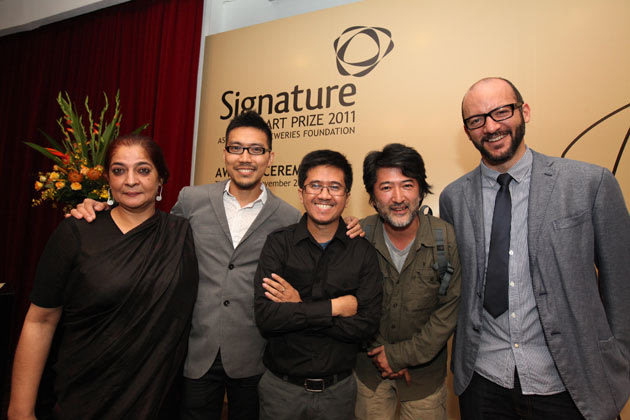
The artworks of 15 finalists, nominated from 24 countries and territories, were presented for the Asia Pacific Breweries (APB) Foundation Signature Art Prize 2011 in a ceremony organised by the museum.


The extensive selection of the finalists from a pool of 130 artworks was carried out by a group of eminent art experts.


With the emphasis on a single signature work of each contender, artists are provided with an uncommon benchmark for all artists — whether they have a long, pedigreed history or not.


Tan Boon Hui, director of SAM, said the focus is to level the playing field and to bring it back to basics: appreciating art for its own sake.


Inaugurated in 2008 and held every three years, the awards aim to cultivate the vibrancy of art-making in Asia Pacific today. The stage has been set for these artists to showcase their artisanal skills to a wider
audience, giving them a platform for recognition they would be hard-pressed to find elsewhere.


"In a competition like this, in which it is open to both emerging and established artists, it is structured to award the prize for a single artwork. It really looks at excellence in the work, so everyone competes on an equal footing. That's very important in opening up the possibilities to look at a diverse a selection of art from the region," Tan said.


The grand prize was presented by Grace Fu, Senior Minister of State for Information, Communications and the Arts.


Grand prize winner Rodel Tapaya, from the Philippines, took home $45,000 for his painting Baston ni Kabunian, Bilang Pero di Mabilang (Cane of Kabunian, numbered but cannot be counted).


The floor-to-ceiling work is an impressive sight to behold, with a dynamic interplay of the past and present. It reflects the folkloric roots interwoven into the history of Tapaya's people, as well as the underlying themes of the devastating effects of nature. Bold colors abound, and even from a distance, painstaking brushstrokes and lovingly-executed details are evident, even to the untrained eye.


Tapaya said that his art is multi-layered in approach. "Philippine folklore is my world, the main theme I create in my work. But I want the viewer to not just see my painting as stories. I want him to look at the deeper perspective, too. So, I added some commentary on why we experience great floods, global-warming, deforestation," he pointed out.

Singapore's very own Michael Lee was also a winner on the celebratory night as he walked away with the People's Choice Award worth $10,000. This was presented by Michael Koh, CEO of the National Heritage Board.


Lee's Second-Hand City is a suite of eight digital prints exploring contemporary life with wit and insight into the machinations of everyday existence. His work showcases an insightful dialectic on living in a concrete jungle — using urban architecture, science fiction and pop culture as his palette and salvo.


This award in particular is the result of the public voting online at SAM's website, or casting their votes in person at the exhibition, prior to the 17th of November date of the ceremony. Lee's art is the undeniable hot-favorite with the public, and deservedly so.


Lee said he creates utopian architecture to encourage dialogue away from polarising debates on conservation. While some might believe conservation is key and others advocate the new as penultimate, he believes a middle-ground is where the answer lies.


"My position begins with moving out from moralising, taking a judgmental position. Morality is important to a certain extent. At its best, it pushes human being to be better. But very often, rules and norms make us complacent and unable to think out of the box — people may not even know they have been restricted. So when I propose imaginary buildings and impossible cities, I'm not saying these are my proposals as a solution. I want my work to be triggers through humor and irony, to get people to see things from a bigger perspective," he explained.


L-R Sheba Chhachi (Jurors Choice), Michael Lee (People's Choice), Rodel Tapaya (Grand Prize), Aida Makoto (Jurors Choice), Daniel Crooks (Jurors Choice). (Photo courtesy of Singapore Art Museum)L-R Sheba Chhachi (Jurors Choice), Michael Lee (People's Choice), Rodel Tapaya (Grand Prize), Aida Makoto (Jurors …


During the night, four more artists were presented awards. Three Jurors' Choice Awards, worth $10,000 each, were given to Daniel Crooks from Australia, Sheba Chhachhi from India and Aida Makoto from Japan. These were presented by Roland Pirmez, advisory committee chairman and board of trustees member of the APB Foundation.


Pirmez spoke of the importance of the melting pot of cultures in the region.


"The foundation was set up to applaud and celebrate the diversity of life, as showcased in the artwork of the Asia Pacific region. The flourishing arts scene in Singapore provides the perfect platform to showcase regional contemporary art, and highlight the way in which it connects us to the communities around us," he said.


The APB Foundation Signature Art Prize 2011 Finalists Exhibition will run from 11November 2011 to 4 March 2012 at the Singapore Art Museum. There will be a series of curatorial talks, artist talks and guided tours held in conjunction with the show to give the public further insight into the works on display.


(Image below of Tapaya work sourced from oneartworld.com)

Contemporary Art in the Philippines is outstanding, there are quite a number of talented young artists here.

One of the most talented contemporary artists of the Philippines is Annie Cabigting. I was walking at an arts event---known as the "ManilArt 10"---in Metro Manila a couple of years ago or about July 2010, when a prominent art blogger Trickie Lopa saw me there and took a photograph of me standing in front of Annie Cabigting's work.

No, I don't own this beautiful Annie Cabigting oil on canvas painting (though I wish I own it!!!). I believe this painter is a talent of Finale art gallery in Makati City, Metro Manila, The Philippines.

Here is the picture sourced from manilaartblogger.wordpress.com


Blog caption:  Wilson Lee Flores and Annie Cabigting's oil on canvas auction piece, "After Yves Klein"


The image below of painter Annie Cabigting and short bio-data are sourced from spot.ph

The artist: Born in 1971, Annie Cabigting majored in painting at the University of the Philippines. She views her craft as means to carry on the work of artists who have inspired her. Her piece After Yves Klein was auctioned off in the 2010 ManilArt.